

And having the best first job ever, on Tim Burton’s “Batman”
Shot like a young rascal into the working creative world, this was my first foray into the working world of work, passionate artistic grown-ups, high egos, and, character clashes.
The year was 1988. I was just out of school and through a tentative connection and a huge dose of luck, I landed a pre-production gig on one of the following year’s biggest films, Tim Burton’s ‘Batman’ at Pinewood Studios. While I was there, I soaked in the creative atmosphere of a place that had seen films like ‘The Ipcress Files’ and ‘A Clockwork Orange’, made in the 60s and 70s, and at the time, more recent classics like, ‘Aliens’, ‘Full Metal Jacket’ and most of the Bond films with the massive ‘007 Bond Stage’ and expansive outdoor water tank.
As I’ve joked a few times, it’s been downhill ever since.
But there I was, shot like a young scamp into the working world as a relatively fresh eighteen-year-old, this was to be my first foray into the working world of work, of passionate artistic grown-ups, high egos and, character clashes. My eyes were about to be fully opened and my brain would explode.
I started at the bottom of the food chain, as a production department runner. And tea and coffee maker. Lackey. Dogsbody. Just there to be shouted at, if necessary.
The production design department was housed in a two-story fifties-era brick building. The main downstairs room featured a large white room made infinitely smaller by the size of many draughtsmen boards which were gigantic white desks. Ten designers filled the room with music, banter, and cigarette smoke as they swapped ideas and beavered away with designs for the Batmobile, the Bat cave, the Batwing, and many prototypes for weapons. You could sense the level of dedication, and pride they had in their work, all eager to please the production designer Anton Furst and art director Terry Ackland-Snow. They were in the offices upstairs. Ultimately, they were all there to satisfy the new young director, Tim Burton.
Computers were acknowledged and discussed, but not yet a common standard. Everything was still drawn by hand and master copies were like gold dust.
Soon I would be running between the production design department and the ‘chippies’ (carpenters), the props department and the flamboyant costume department, and dropping off a variety of blueprints and plans, having printed six or seven copies. As I ran one errand on my first few days, I was disappointed to see that the famous Pinewood water tank, seen in many an illustrious films like ‘Dr. No‘ and ‘Alien‘ clearly hadn’t seen much action that year. The tank was drained and looked far from ready for the magic of the film-making.
“SHIELDS!”
The real action was happening in the production department. The Batwing concept was born in that room and one time, I overheard the production design team talking. I remember Art Director and concept artist Nigel Phelps, shouting ‘shields’, and a rendering of the ‘protective barrier concept’ around the Batmobile was realized over an afternoon. I was enthralled.
Then, a couple of days later, I saw ‘it’ for the first time. I weaved through a rabbit warren of prop rooms and spaces packed with white primed wooden spiral stairs that led to nowhere and piles of offcuts of wood. White paint splatters and plaster dust covered the floors. I was dropping off more printed plans to the chippies. Light of foot, I bounced down a corridor next and rounded a corner, stepped into a cavernous light-filled room. Four or five people with hazmat suits and dust masks busied themselves. One of them approached. They looked at the bundle of plans in my arms and pointed to a huge desk in the corner. They stepped aside and then I saw it.
THE BATMOBILE!
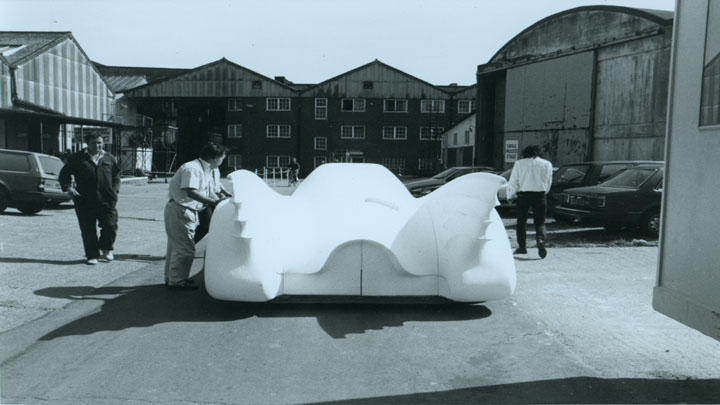
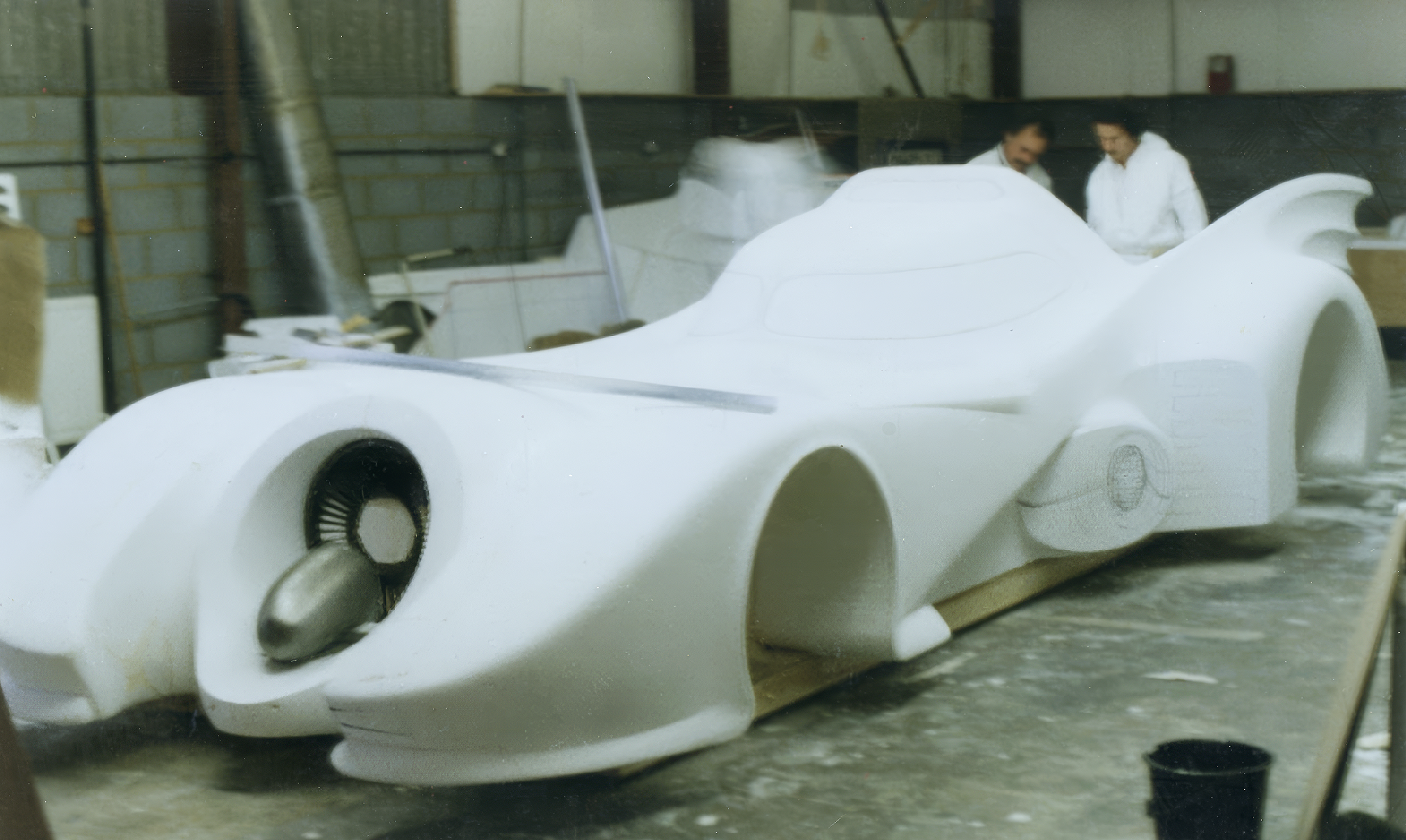
This version was pure white and fabricated from fiberglass. It was missing wheels and raised on a low plinth. A version of a metallic grill nestled in a circular opening at the front. Its significance wasn’t lost on me and stood motionless for a second or two.
This was one of seven created for the film. Over the next few days, I saw three more. Ones that would be pushed into position and like the one I saw, some would have a functioning engine, be driveable, and be fully pimped out with final interior decoration.
I was a bystander when Terry A-S showed Tim Burton the latest version. I could tell it was a crucial component of the set and noticed the seriousness with which discussions took place, just out of earshot. Preoccupied and with backs turned, I stole a moment with my camera. No time to check the settings and steady myself. Just shoot. Ask for permission? It would have been a definitive ‘No’.
Murmurs and rumors dominated the set. The young American Director was surrounded by a crew of mostly Brits on a British film set. Warner Brothers had entrusted the reins of this massive film to the hugely talented director on only his third live-action film. American reinforcements were to be here in the next few days I was told. Some Warner Bros. suits came and went. Then came the day was told to be on high alert, with imminent visiting VIPs. Coffee or tea or drinks requests had to be ready.
I was looking over plans of a disused factory that was a few miles away. I had visited, taken photos, and was building primitive structures over the top of a floor plan, so Mr. Burton and his Director of Photography, Roger Pratt, could discuss where initial camera placements would be. Then I heard booming voices from downstairs. I was given a drinks request by another runner, with a look on their face like ‘Don’t fuck-it up!’
It’s Jack!
I carried the tray of drinks to the second floor where the storyboard artists had their office on the second floor. I walked beyond the threshold of the room and scanned the room, the walls of which were covered from floor to ceiling in storyboard sketches. I recognized the board artists and the Production designer Anton Furst. There was also another male guest in a long dark coat and a brown fedora hat. “Excuse me, Sir”, I murmured. The unmistakable penetrating eyes that are full of mischief are locked onto mine. Jack Nicholson’s eyes narrowed, his eyebrows arched and he graciously accepted the cup of coffee I was offering him. He didn’t disappoint. “Well, I guess someone has to make coffee around here. Thanks, Kid.”


